

Overview: This guide explains how a catalytic converter’s price is determined from its code in Finland. We go through where to find the code, how the converter library and the laboratory XRF analysis work together, why code-based valuation is more accurate than a visual estimate, plus examples from the Opel Astra and Honda Civic. The guide is for motorists, garages and businesses who want to sell a converter at the right price.
Key points
- A converter’s value in Finland is typically 50–900 €, and the exact price is based on the precious metals inside: platinum, palladium and rhodium.
- The converter’s code — the manufacturer or serial number — is stamped into the metal casing and is the key to accurate identification.
- The code is matched against a converter library — at Metalaxis, a database of over 30,000 analysed units — which reveals the model’s PGM content.
- The final value is confirmed by XRF analysis, which measures the actual precious-metal content.
- Two identical-looking converters can be worth very different amounts, so the code and analysis are more accurate than a visual estimate.
- An original converter is typically worth clearly more than an aftermarket part.
Intro: If you are looking for what a catalytic converter price by code is, the short answer is this: the code identifies the exact model of the converter, whose precious-metal content is already known, and the final price is calculated from that content and the day’s metal prices. In other words, catalytic converter price by code is not a guess but a figure based on measurement. In this guide we go through how identification and valuation proceed in practice at Metalaxis.
What is the converter code and where do you find it?
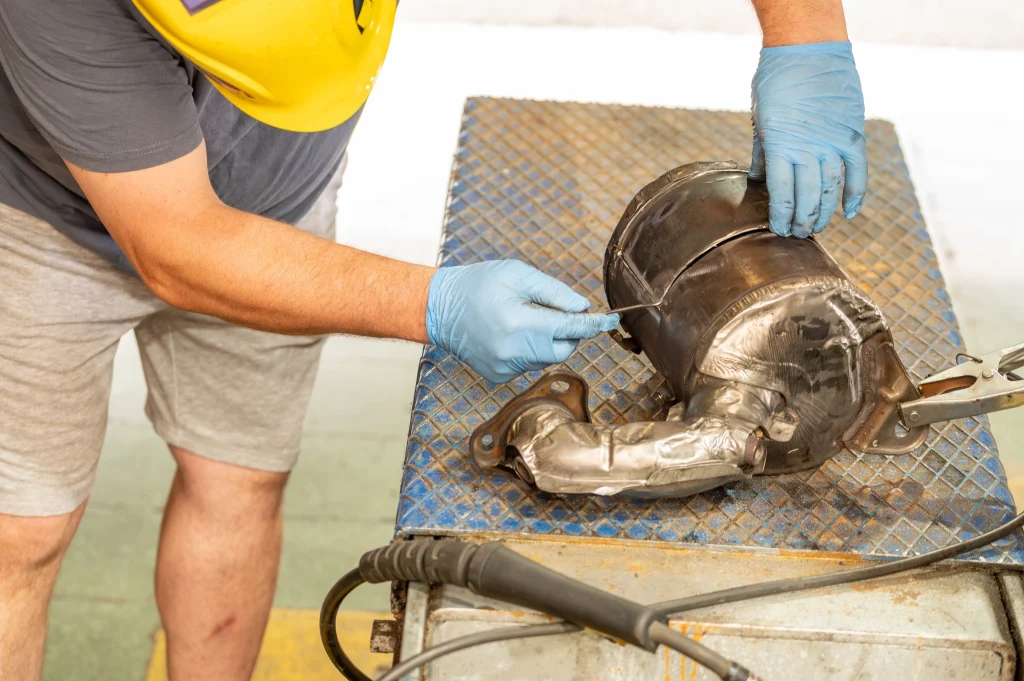
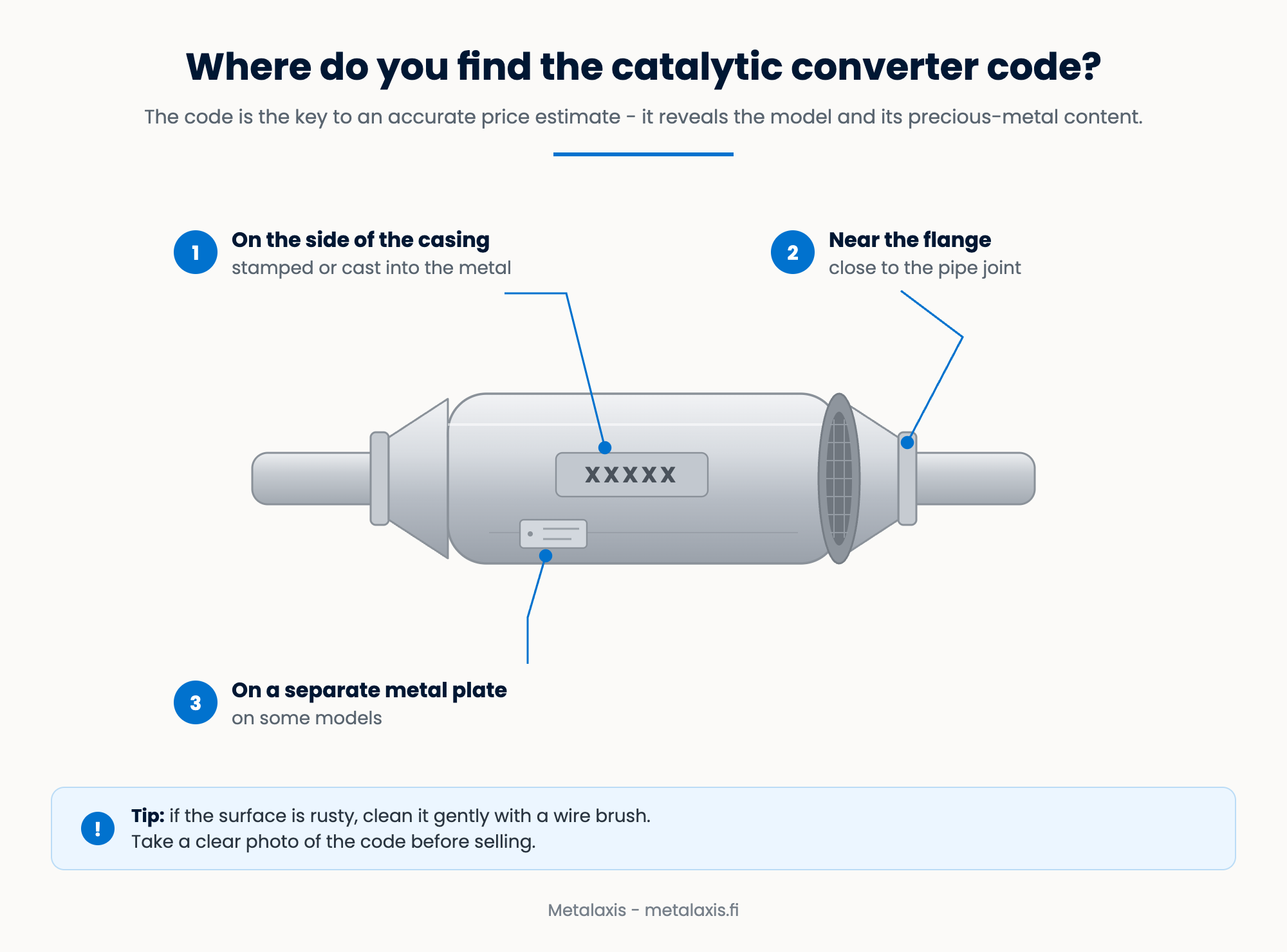
The converter code is the manufacturer’s unique marking, stamped or cast directly into the converter’s metal casing. This converter code tells which manufacturer and model the unit is — and that is exactly what determines how much precious metal the part contains. The code is usually found on the side of the casing or near the flange, sometimes on a separate metal plate. If the surface is rusty, the code can often be revealed by cleaning it carefully with a wire brush.
It is worth noting the code before selling, because it speeds up valuation significantly. When you send the code and a few photos in advance, the buyer can give a preliminary estimate even before the part arrives. Without the code, identification relies on model images and dimensions, which is slower and less accurate.
How is the catalytic converter price determined by code?
The catalytic converter price by code is determined in four steps: the code is read from the casing, it is matched to a database, the database gives the model’s known PGM content, and the final value is confirmed by laboratory analysis and calculated according to the day’s metal prices. This way the final figure reflects the part’s real content rather than a general average.
In practice the price is formed from a formula that combines the recoverable amount of platinum, palladium and rhodium and these metals’ current market price. Because metal rates fluctuate daily, the converter’s price also moves with the market. Metalaxis monitors the world-market prices of precious metals continuously and updates its purchase prices accordingly, so how the converter’s price is formed stays transparent throughout the process.
What is a converter library and how does it work?
A converter library is a database that gathers code-specific information on a large number of different converter models. Metalaxis’s converter library contains over 30,000 chemically analysed units, and for each one the manufacturer code, PGM content, model-specific images and exact lab results have been stored. When the code is entered into the library, the system finds the matching model and its known precious-metal content in an instant.
This is the decisive difference between a reliable and a vague buyer. A valuation that leans on the library is based on thousands of real analyses, whereas without a database the price easily remains a rough guess. The library does not, however, replace the final measurement — it gives the starting point that the XRF analysis confirms.
How XRF analysis confirms an accurate value
XRF analysis — X-ray fluorescence measurement — determines the converter’s real platinum, palladium and rhodium content at laboratory level. Although the code and library tell the model’s expected content, an individual part’s content can vary with age, condition and use. XRF removes the guesswork: it measures what the part actually contains.
This is exactly why the code and the analysis complement each other. The code identifies the model quickly, and the analysis confirms the final amount. Thanks to this the estimate becomes both fast and accurate, and the seller can request an analysis report that documents what the price is based on.
Estimated price ranges for converters in Finland (2026)
| Vehicle class | Price range (€) | PGM content (est.) |
|---|---|---|
| Small cars (e.g. Honda, Toyota) | €50–200 | 3–5 g |
| Mid-size sedans (e.g. VW, BMW) | €150–400 | 5–8 g |
| Large SUVs and vans | €300–600 | 8–12 g |
| Hybrids (e.g. Prius) | €400–900 | 10–15 g |
| Diesel vehicles | €100–350 | 4–8 g |
| Aftermarket converters | €20–50 | 1–2 g |
Source: Metalaxis — estimates based on the January 2026 market situation. Actual value is based on laboratory analysis.
Examples: Opel Astra and Honda Civic
Opel Astra catalytic converter price
The Opel Astra catalytic converter price falls, based on its vehicle class, typically into the small-to-mid-size car range. The final figure, however, depends on the engine, the model year, and whether the part is original or aftermarket. Two Astras with different engine options can produce a different price even if the part looks externally the same — that is why the code, not just the model, decides the exact value. When you send the code and photos in advance, you get an estimate that fits the model quickly.
Honda Civic catalytic converter
The Honda Civic catalytic converter belongs to the small-car class, whose typical range is about €50–200. The petrol, hybrid and aftermarket versions, however, differ clearly in precious-metal content, so brand and model alone are not enough for an accurate price. The code tells which variant it is, and the analysis confirms the content. You’ll find more about model-specific pricing in the article how much does a catalytic converter cost in Finland in 2026.
Why is code-based valuation more accurate than a visual one?
Valuation based on the code and analysis is more accurate because it measures the real precious-metal content instead of classifying the part by appearance. Many buyers apply standard price lists or general estimates, which can undervalue units with above-average content. Two same-sized converters can contain very different amounts of recoverable metal, so a visual estimate often leaves money on the table.
The difference stands out between original and aftermarket parts. Aftermarket converters typically contain only 10–30 percent of the precious-metal content of an original part. That is why it is important to know, via the code, which one it is before you accept an offer. This is also part of responsible catalytic converter valuation in Finland, where the price is based on the material’s content rather than a promise.
This is how you sell a converter using the code
The sales process is straightforward. First find the code on the casing and take clear photos of it and of the whole part. Send the code and photos to the buyer for a preliminary estimate, or bring the part directly to the facility for accurate XRF testing. After the analysis you get an offer, and once accepted, payment is made quickly by bank transfer. Collection can be arranged for larger batches.
Always sell to a licensed recycling facility that is in the ELY Centre register. Converter thefts have become more common in Finland, so a reliable buyer follows anti-theft practices and may ask for an ID document as well as proof of ownership, such as a registration certificate or a scrapping certificate. Proper documentation protects the honest seller and keeps the transaction lawful.
What factors affect the price besides the code?
The code and analysis identify the precious-metal content, but other factors also affect the final price. Metalaxis assesses each batch as a whole, taking into account the following:
- Precious-metal market price: the day’s rate for platinum, palladium and rhodium is the single biggest factor affecting the price.
- Original or aftermarket part: an aftermarket converter typically contains only 10–30 percent of an original part’s precious-metal content.
- Physical condition: an intact honeycomb keeps its value, whereas an emptied or damaged unit loses a large part of its recoverable content.
- Batch size: larger batches can be processed more efficiently, and collection can be arranged for them.
Understanding these factors helps you assess a converter’s value and avoid selling too cheaply. When the code, the analysis and the market price are combined, the price is based on the part’s real content.
Why do precious-metal prices affect a converter’s value?
A converter’s value is directly tied to the world-market prices of platinum, palladium and rhodium. When the rate of one metal rises, the value of a converter with the same content rises in the same proportion. In late 2025 and early 2026 precious-metal prices reached multi-year highs, which has raised converter prices compared with previous years.
The auto industry is the largest consumer of precious metals, and converters account for a significant part of platinum and palladium demand. According to the U.S. Geological Survey, recycling covers a considerable part of the supply of these metals, which keeps demand for used converters strong even as electric vehicles become more common. According to research, used auto catalysts contain even more precious metal than many natural ores, which makes them an exceptionally valuable recycling source.
Summary
The catalytic converter price by code rests on a clear chain: the code identifies the model, the converter library tells its expected precious-metal content, and the XRF analysis confirms the real content, which is priced according to the day’s metal prices. This way the estimate is both fast and accurate, and based on the material’s real value. When you want to know your own converter’s value, note the code and request an estimate from Metalaxis — you get transparent pricing and fast payment.


