
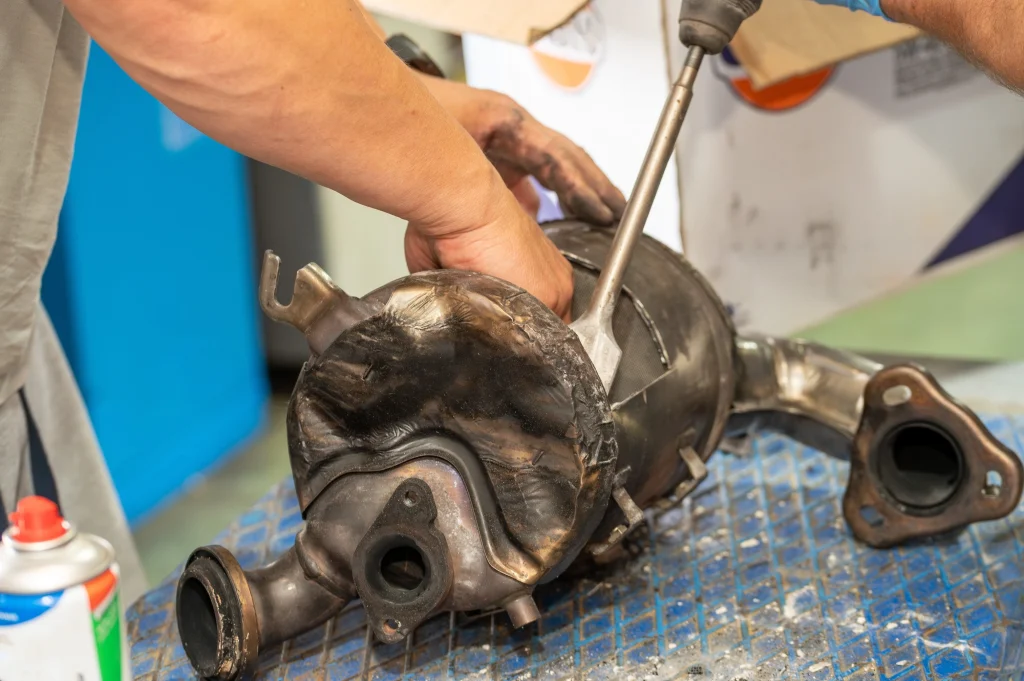

Overview: This guide is aimed at workshops, dismantlers, and car dealerships that want to sell used catalytic converters reliably and at the best price. We cover how buying from businesses works, how the price is set, how bulk batches are collected and paid for, and what legal selling requires. The goal is a clear, repeatable process that brings your business additional income.
Key Takeaways
- Selling catalytic converters for businesses is best built into a repeatable process where the price is based on precious-metal content, not guesswork.
- Buying from workshops suits a steady, smaller flow; buying from dismantlers suits larger bulk batches and collection.
- The most accurate price comes from identifying the unit (code) and analysis, not from a visual estimate alone.
- The current market price of precious metals directly affects the offer, so the timing of a sale matters.
- Legal selling requires the proper permits, documentation, and traceable payments – for dismantlers in particular, ELV regulation is central.
- A reliable partner offers transparent pricing, collection logistics, and fast payment.
For businesses, selling catalytic converters is in practice a recurring source of income once the process is in place. The key starting point is that the price is based on the unit’s real precious-metal content and the current market, not on guesswork. In this guide we go through how selling catalytic converters for businesses should be handled – from workshop to dismantler – so that you get a fair price and keep the operation legal and traceable. The difference from private selling is clear: a business sells regularly and often in larger quantities, so the smoothness of the process, pricing transparency, and documentation determine how much is ultimately left over.
Why does selling catalytic converters for businesses pay off?
Selling catalytic converters for businesses pays off because used units contain valuable precious metals that would otherwise go unused. A converter’s core holds platinum, palladium, and rhodium, and these metals can be recovered and returned to industrial use. For a business, this means the old parts piling up in storage are real capital.
According to a ScienceDirect review, used catalytic converters contain precious metals in even higher concentrations than natural ores, and they supply more than half of Europe’s precious-metal demand. This explains why a reliable partner genuinely pays for a used unit – and why it is worth organising even a steady flow properly.
The benefit for a business is twofold. First, old parts generate direct additional income that would otherwise go unrealised or end up mixed in with ordinary scrap metal at a fraction of the price. Second, responsible recycling supports the company’s environmental profile and meets the industry’s expectations for material recovery. As long as precious-metal demand stays strong, the value of used converters holds up, and regular selling forms a predictable revenue stream in a workshop’s or dismantler’s cash flow.
Scale makes the difference significant. A single unit may not seem like much, but tens or hundreds of units a year add up to a sum worth managing deliberately. So from a business’s perspective, it is not irrelevant who the parts are sold to and on what basis the price is calculated – and this is exactly what this guide gives practical tools for.
Buying catalytic converters from workshops: how it works
Buying catalytic converters from workshops is usually based on a steady, smaller flow: replaced parts accumulate alongside the work. For a workshop, the most important thing is that every part is identified and priced correctly, and that selling happens without extra administrative hassle. A good partner receives parts flexibly and gives a clear offer.
In practice, a workshop should gather the parts into tidy batches, record the vehicle details, and keep the parts intact. The better a part can be identified, the faster and more accurately an offer is made. This way the workshop gets steady additional income from replaced converters without it taking time away from the actual work.
How to collect parts as part of the daily routine
The smoothest way is to integrate collection into the normal workflow: when an old part is removed, it is recorded and moved to a separate collection bin. This way parts don’t go missing or get mixed with other scrap metal, whose value is a fraction of a converter’s. It’s worth noting the vehicle’s make, model, and year, since this information speeds up identification and improves the accuracy of the offer. Even at a larger workshop this takes little time, but the accumulated benefit can be significant over a year.
For many workshops the easiest model is to arrange regular collection or delivery, so the parts don’t sit around taking up storage space. When the partner is the same time after time, pricing also stays comparable and the cooperation develops into a routine.
Buying catalytic converters from dismantlers: bulk batches and logistics
Buying catalytic converters from dismantlers differs from workshops in that it typically involves larger bulk batches. For a dismantler, what matters is efficient collection, reliable identification, and pricing that holds up to scrutiny even in large quantities. When there are many batches, even small differences in unit price compound into significant sums.
Dismantlers are also subject to regulation. The European Commission’s End-of-Life Vehicles (ELV) Directive requires that the dismantling and treatment of vehicles takes place in a licensed and controlled way. This means selling catalytic converters is best handled with a partner that operates with the appropriate permits and documents the batches correctly.
For a dismantler, the catalytic converter is one of the most valuable individual parts removed from a vehicle. The ELV Directive requires that end-of-life vehicles be pre-treated in a controlled way – hazardous fluids and components are removed before shredding – and the converter is among these parts to be recovered. When a dismantler sells the batches to a licensed recycler, it simultaneously meets regulatory requirements and gets full value for the parts. In large batches, the importance of identification and analysis is emphasised, because the small value differences of individual parts add up quickly.
Collection and bulk-batch logistics
Logistics are worth agreeing in advance: when the batch size and collection schedule are clear, the dismantler avoids unnecessary storage and gets paid smoothly. Clear per-batch recording also helps internal tracking and makes recurring cooperation predictable.
How is buying catalytic converters priced?
Buying catalytic converters is priced based on the unit’s precious-metal content and the current market price. What is decisive is not weight or appearance, but how much platinum, palladium, and rhodium the unit contains. That is why two nearly identical-looking parts can differ significantly in value.
The three factors that decide the price
In practice, pricing combines three things: the measured precious-metal content, the current world-market price of precious metals, and the condition and identifiability of the part. Original (OEM) parts typically contain more precious metal than aftermarket parts, which shows directly in the price. Transparent pricing is essential for a business: when you can see how the price is formed, you can compare offers reliably and plan selling as part of the business rather than as a random extra.
Code or analysis?
The most accurate price is based on identifying and analysing the part. Metalaxis uses XRF analysis and a database of over 30,000 analysed catalytic converters, so the estimate is based on measured data rather than guesswork. XRF analysis measures the precious-metal content from the part itself, and the extensive database helps identify the model quickly even when the markings are worn. For a business, this means the price can be justified and repeated from one batch to the next. A business should also follow the market: read more about how much a catalytic converter costs in Finland in 2026, as well as how the catalytic converter price is formed.
When is a catalytic converter bought at the best price?
A catalytic converter is bought at the best price when precious-metal market prices are high and the parts have been identified correctly. Because the prices of platinum, palladium, and rhodium change daily, the value of the same part can vary from week to week. For a business, this means timing matters – but for a continuous flow of sales, steady, transparent pricing is more important than chasing the absolute peak.
A practical tip for businesses: follow the market trend at a rough level and agree on a clear pricing model with your partner. This way you avoid needless speculation and get predictable income.
For large sellers, such as dismantlers, it’s also worth considering batch-level timing: if a lot of parts accumulate in storage, staggering the sales can smooth out the effect of market swings. On the other hand, storing parts for a long time ties up capital and space, so for most businesses the most profitable approach is steady, regular selling with a reliable partner rather than guessing the market’s peak.
What happens in the catalytic converter buying process?
Buying a catalytic converter generally proceeds through the same stages regardless of whether the seller is a workshop or a dismantler. The process is designed to be fast and transparent, so the business knows how the price is formed.
- Receipt or collection of parts (for bulk batches, logistics are agreed in advance)
- Identification based on code and model
- Analysis to determine precious-metal content
- Price estimate relative to the current market
- Offer, acceptance, and traceable payment
Every stage is documented, so the business sees how the final price is formed. Transparency is especially important for business customers who need a clear audit trail for accounting and internal tracking. A well-functioning process is also fast: the better the initial information given about the parts, the more smoothly identification, analysis, and payment proceed.
| Seller type | Typical batch | What stands out |
|---|---|---|
| Workshop | Small, steady flow | Easy receipt, quick offer |
| Dismantler | Large bulk batches | Collection, identification, regulation (ELV) |
| Car dealership | Variable | Transparent pricing, documentation |
Source: Metalaxis – business-buying practices; price estimates are always confirmed by analysis.
Workshop or dismantler? How selling catalytic converters differs
The focus depends on whether units arrive as a steady trickle or in large batches.
Workshop
- Batch size
Small, steady flow – units build up during everyday jobs. - What matters most
Easy drop-off and a quick quote. - Regulation
Lighter – normal record-keeping and documentation.
Dismantler
- Batch size
Large bulk batches at once. - What matters most
Collection, reliable identification, and pricing at volume. - Regulation
ELV rules apply; dismantling is a licensed activity.
In both cases the price is based on precious-metal content and current market values – not on weight or looks.
How a catalytic converter is bought legally and traceably
When a catalytic converter is bought from a business, legality and traceability are as important as price. In practice this means proper permits, clear documentation, and traceable payments. Metalaxis operates under ELY Centre permits and with ISO certification, which ensures batches are handled according to the rules.
For a business, this is also risk management: when a catalytic converter is bought with documentation, both parties are protected and the bookkeeping stays in order. For dismantlers, ELV regulation emphasises this further, since vehicle dismantling is a licensed activity.
Documentation and traceability in practice
In practice, traceability means that a clear record remains of every batch: what was sold, when, and at what price. This helps the company’s bookkeeping and, if needed, demonstrates that the parts were handled appropriately. With a licensed and certified partner, the business can focus on its core activity and trust that recycling is handled according to industry rules.
It’s also worth making sure the partner openly explains how the parts are handled and how the price was calculated. A transparent approach is the best protection against both underpricing and ambiguity, and it makes the cooperation long-term. Once the process has been agreed, selling becomes a routine that repeats effortlessly month after month.
Summary
For businesses, selling catalytic converters is at its best a predictable source of income: identify the parts, price them based on measured data, agree the logistics, and keep the process legal. For a workshop, an easy, steady flow stands out; for a dismantler, bulk batches, collection, and regulation. When a partner offers transparent pricing and fast payment, selling becomes effortless. Start by getting to know how catalytic converter recycling and buying works in practice, and request a quote for your business.
FAQ
Business selling emphasises recurrence, volume, and documentation. A workshop or dismantler sells parts regularly, so transparent pricing and smooth logistics matter more than in a one-off sale. In addition, the business must take care of bookkeeping and legality, which makes a reliable partner especially valuable.
The price depends on the unit’s precious-metal content and the current market price, so it varies from model to model. The value of a single converter can range from tens of euros to several hundred euros. The most accurate estimate comes from identifying the part and analysing it, not from a visual estimate.
Larger batches are usually agreed in advance: logistics and collection are arranged with the business, and batches are identified and analysed before the final price. Payment is made traceably, which keeps both parties’ bookkeeping in order. For dismantlers, this is part of proper, licensed operation.
A business should keep records of the batches sold and the related vehicle details, and make sure the partner operates with the appropriate permits. Dismantlers are subject to the End-of-Life Vehicles (ELV) Directive, which requires licensed treatment. A documented, traceable payment protects both parties.
Both. The part’s manufacturer code helps identify the model and its typical precious-metal content, but the most accurate price is based on analysis. Metalaxis combines code-based identification with XRF analysis and an extensive converter database, so the estimate is based on measured data.
Yes, but the value is usually lower. A damaged or incomplete part is harder to identify and may be missing precious metal, which lowers the price. Aftermarket parts typically contain less precious metal than original parts. It’s still worth selling them properly rather than discarding them, since they too hold recoverable value.


