
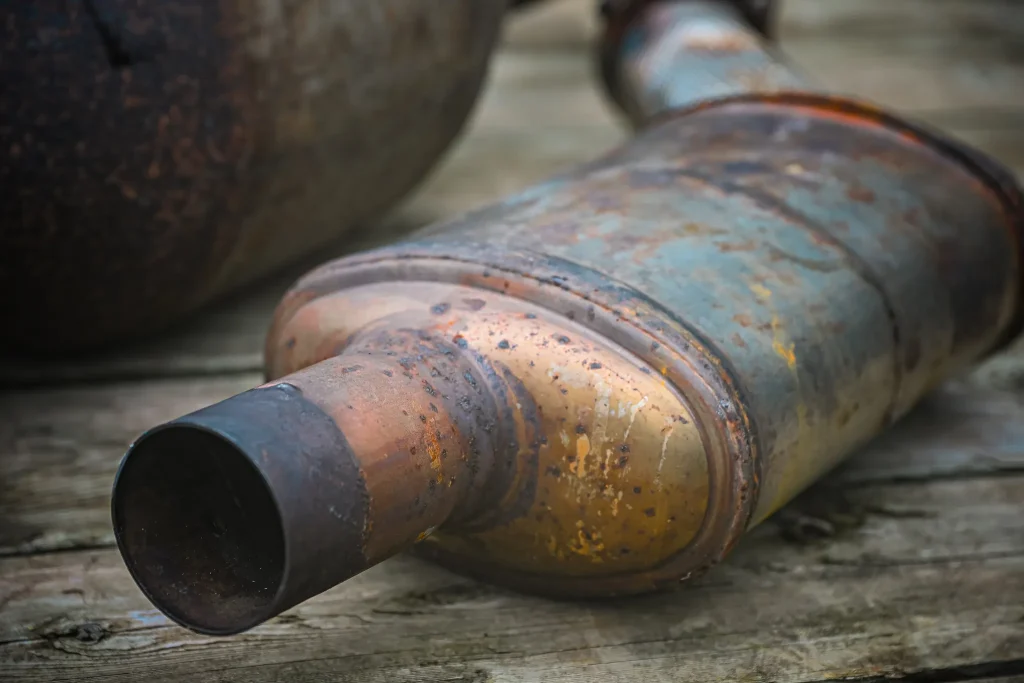

Overview: Selling a used catalytic converter is worthwhile because the part contains valuable precious metals. This guide explains where you can sell a catalytic converter, who buys them, how the value is worked out, and what you need to know about legality and tax before the sale.
Key Takeaways
- A converter’s value comes from platinum, palladium and rhodium – not from the steel shell.
- The best price comes from a specialist recycler that sets the value by analysis, not by a flat scrap rate.
- Keep the unit intact and note the vehicle details – good starting information speeds up the valuation.
- Do not remove a converter from a road-legal car yourself – it is illegal and fails the roadworthiness test.
- In Finland a single unit is typically worth somewhere between 50 and 900 euros, depending on its precious-metal content.
- Business sales often fall under the reverse-charge VAT rules, so check the tax treatment in advance.
Selling a used catalytic converter means selling the old part that has been replaced on a car to a recycler, because of the precious metals it contains. Selling a used catalytic converter is entirely legal when the part comes from a lawful source and the sale is handled properly. This guide explains where you can sell the part, who buys it, and how to get the best price for it.
What does selling a used catalytic converter mean?
When a new catalytic converter is fitted to a car, the old part is left over – and it should not be thrown in with mixed scrap. The old unit still holds recoverable precious metals, so it has real monetary value. In practice, selling means delivering the part to a recycler that identifies it, determines its precious-metal content and pays the market price for it. A replaced converter is therefore rarely just waste: it is a used part with residual material value. That is exactly why it is worth finding out the value before you decide where to send it.
Why is a used catalytic converter valuable?
A used catalytic converter is valuable because its ceramic honeycomb is coated with platinum, palladium and rhodium. These metals are rare and in demand, and they can be recovered and reused. According to a review on ScienceDirect, used converters can contain precious metals at even higher concentrations than natural ore, which explains why they are genuinely worth paying for. The steel shell, by contrast, has little value – everything comes down to the coating. The proportions of the metals vary by car: diesel converters lean towards platinum, while petrol cars have relatively more palladium and rhodium. Of these, rhodium is usually the most valuable, so units rich in rhodium clearly raise the final price. A single passenger-car converter typically holds only a few grams of precious metal, but it is precisely this small amount that decides the value. Recovering precious metals from used parts also makes environmental sense, because it reduces the need to mine new ore. A recycled unit returns valuable metals to circulation instead of letting them go to waste.
Where to sell a catalytic converter?
When you are wondering where to sell a catalytic converter, there are essentially three options: a specialist catalytic converter recycler, a general scrapyard, or an online marketplace. A specialist recycler sets the value by a precious-metal analysis and usually pays the best price. A general scrapyard may offer a flat price, which often undervalues the part. Selling on an online marketplace leaves the price uncertain, with no guarantee that the value is correct. In private sales, the responsibility for identifying the part and its origin also tends to fall on the seller, which can complicate the deal. With a specialist recycler, these matters are handled as part of the normal process. It is also worth noting that the price can vary between operators, so asking for a single valuation is not always enough. When you understand what the price is based on, you can judge how reliable an offer is and avoid selling too cheaply.
In practice, the best and safest route is an operator that can identify the part and justify its offer. If a buyer will not explain how the price is formed, it is worth being cautious. The advice is the same whether you search online for “sell a catalytic converter” or “catalytic converter for cash”: choose an operator that bases its price on measured data. A specialist recycler also has the advantage of being able to handle many kinds of parts and to advise you if you are unsure of a part’s origin or type.
Who buys catalytic converters?
To the question of who buys catalytic converters, the answer is above all licensed recycling companies. Metalaxis is an ISO-certified Finnish recycler operating under ELY Centre permits, buying both single parts and larger batches from garages and dismantlers. A reliable buyer asks for details of the part’s origin, identifies it, and determines the value by measurement – not by eye. Garages and vehicle dismantlers often sell catalytic converters regularly in larger batches, whereas for private individuals it is usually a single replaced part. In both cases the principle is the same: the better the part can be identified and the more transparent the pricing, the more certain the deal is for both sides. For larger batches it is also worth agreeing on collection or delivery in advance, so the process runs smoothly.
Where to sell your catalytic converter? Three channels compared
The channel you choose directly affects how much you get for an old unit. Here is how the three most common options differ.
Specialist recycler
Recommended
- •Value set by a precious-metal assay and the current market price.
- •Usually pays the best price.
- •Identifies the unit and explains the quote.
- •Handles origin and paperwork as part of the process.
General scrapyard
- •Often offers a flat per-unit price.
- •Easily undervalues what the unit actually contains.
- •Fast, but based on an average rather than a measurement.
- •Rarely analyses what is inside.
Online marketplace
- •Uncertain price, with no guarantees.
- •No assay and no verification of value.
- •Identification and origin fall on the seller.
- •Higher risk, slower, and without support.
Bottom line: The reliable route is a buyer who measures the unit and justifies the price – not a fixed rate or a guess.
How to sell a catalytic converter – step by step
When you want to sell a catalytic converter sensibly, the process is straightforward. Identify the part, request a valuation, agree the terms and deliver the part. A clear sequence ensures you get a fair price and are not left guessing. The steps are the same whether you sell a single part or several at once, and they suit both a private individual and a garage.
- Identification: note the car’s make, model and year, along with any part manufacturer code.
- Valuation: ask the recycler for a valuation based on analysis and the current market price.
- Terms: confirm the payment method, timetable and any collection or delivery.
- Delivery: deliver the intact part as agreed and keep the receipt of sale.
What do you need to bring?
In practice you need the part itself, as intact as possible, details of the vehicle it came from, and proof of identity for the sale. The better the part can be identified, the more accurate and reliable the valuation. It is not worth opening or emptying the part yourself, as that removes precisely the material that carries the value. If the part comes from a garage, the paperwork produced during the replacement job also helps confirm the origin. Clear information speeds up the valuation and reduces uncertainty on both sides. If you are unsure of the type or origin of the part, it is worth asking the recycler for advice before delivery – it saves time for both.
Catalytic converter for cash: how the value is worked out
When you turn a catalytic converter into cash, the final sum depends on the precious-metal content, the condition of the part and the day’s market price. Metalaxis uses XRF analysis and a database of more than 30,000 analysed catalytic converters, so the valuation is based on measured data rather than guesswork. This means the same part can be worth different amounts in different weeks, because precious-metal quotations change. Analysis-based pricing is in the seller’s interest, because it distinguishes valuable parts from ordinary ones instead of offering everyone the same flat sum. When the value is based on measured content, even rarer, high-precious-metal parts are valued correctly. The analysis method also reduces errors: when the value is based on measurement, both seller and buyer can trust that the price matches the part’s real content.
You can read more about how much a catalytic converter costs in Finland in 2026, and about how the price of a catalytic converter is formed. In Finland a single unit is typically worth somewhere between 50 and 900 euros, but the most valuable, rhodium-rich parts can exceed this.
When is the best time to sell a catalytic converter?
Because the value follows the precious-metals market, timing can matter too. The quotations for platinum, palladium and rhodium move, so the value of the same part can vary from one week to the next. For a single part, however, it is generally not worth waiting for the perfect moment, since a reliable recycler always pays according to the current market price. For a larger batch, timing can be considered more carefully, and for valuable, rhodium-rich parts some monitoring may be justified. In practice, the most important thing is to sell to a reliable operator that prices the part in line with the current market.
Scrap catalytic converter or intact part?
Many people refer to the old part as a scrap catalytic converter, but its condition affects the value significantly. An intact part, with its honeycomb and coating still in place, is worth more than a damaged, emptied or partly missing unit. Even if a part looks like scrap, it may still contain recoverable precious metal – so it is worth asking for a valuation before you hand it over as mixed scrap. On the other hand, a part that has been deliberately emptied, or whose contents have gone missing, is always valued lower. That is why it is worth keeping the part as it is and letting an expert do the valuation. If the part was damaged during removal, that does not make it worthless – but the final sum is likely to be lower than for an intact unit. The best way to be sure of the right price is not to guess the effect of condition yourself, but to ask for a valuation before handing it over.
Legality and tax – what the seller needs to know
Selling a used catalytic converter is legal when the part comes from a lawful source. The key point is that a converter must not be removed from a road-legal car – doing so is illegal and leads to a failed roadworthiness test. When a whole car is taken out of use, it must be delivered for official recycling; according to Traficom, you then receive a certificate of destruction and the vehicle is permanently removed from the register.
On tax, a private individual’s occasional sale is simple, but sales between businesses often fall under the reverse-charge VAT rules for scrap metal, meaning the buyer accounts for the VAT. In practice this means the seller does not add VAT to the invoice; instead, the buyer reports and pays it. For a private individual, income from an occasional sale may be taxable, so in unclear cases it is worth checking your own situation. This way you avoid surprises later and the sale stays fully compliant.
The exact conditions for the reverse charge, the invoicing requirements and the rest of the sale are covered in our guide to selling a catalytic converter in Finland: price, valuation and recycling.
| Sales channel | How the value is set |
|---|---|
| Specialist recycler | Precious-metal analysis and market price – best price |
| General scrapyard | Flat price – often undervalues the part |
| Online marketplace | Uncertain price – no guarantees, no analysis |
Source: Metalaxis – indicative comparison; the exact value is always confirmed by analysis.
Conclusion
Selling a used catalytic converter is a sensible way to realise the true value of an old part. The value comes from precious metals, so the best price comes from an analysis-based recycler rather than a flat scrap rate. Keep the part intact, note the vehicle details, and confirm legality and tax in advance. This way you make sure the old part is not wasted but its real value is recovered and the precious metals return to circulation. Find out what your own part is worth by requesting a catalytic converter recycling valuation.
FAQ
You can sell a used catalytic converter to a specialist recycler, a general scrapyard, or privately. The best and safest option is a licensed recycler that sets the value by a precious-metal analysis and pays the market price. This way you avoid a flat scrap rate, which often undervalues the part.
Catalytic converters are bought above all by licensed recycling companies, which accept both single parts and larger batches from garages and dismantlers. A reliable buyer identifies the part, asks about its origin, and determines the value by measurement rather than by eye.
In Finland a single catalytic converter is typically worth somewhere between 50 and 900 euros, and the most valuable, rhodium-rich parts can exceed this. The final sum depends on the precious-metal content, the condition of the part and the day’s market price, so a reliable valuation is always based on analysis.
Yes, when the part comes from a lawful source. However, a converter must not be removed from a road-legal car, as that is illegal and fails the roadworthiness test. When a whole car is taken out of use, it is delivered for official recycling, which issues a certificate of destruction.
Bring the part itself, as intact as possible, details of the vehicle it came from, and proof of identity. These help identify the part and confirm its lawful origin, which speeds up the sale and improves the accuracy of the valuation.
A specialist recycler usually pays better, because it sets the value by a precious-metal analysis rather than a flat scrap rate. A general scrapyard may be quick, but a flat price often undervalues the part’s true precious-metal content.
The value is determined by identifying the part and measuring its precious-metal content, typically by XRF analysis. The measured content is priced against the current market price, so the offer is based on real data rather than guesswork.


