

Key Takeaways
- The converter sits in the exhaust system between the engine’s exhaust manifold and the silencer.
- On most modern cars it is in the engine bay, straight after the exhaust manifold or built into it, so it warms up quickly after a cold start.
- On older cars it is usually under the floor of the car, roughly beneath the front seats.
- Some cars have two units in a row, and on V engines each bank of cylinders can have its own converter.
- You can recognise the converter as a metal casing noticeably wider than the exhaust pipe, usually with an oxygen sensor in front of it and another behind it.
- Underfloor units are an easier target for thieves. Finnish police advise fitting a protective plate and engraving your registration number on the casing.
- According to Metalaxis, a used converter in Finland is typically worth between €50 and €900 (2026), so a second unit is worth keeping too.
Where Is the Catalytic Converter Located?
Where is the catalytic converter located along the exhaust? It is one of the first components after the engine. Exhaust gases travel from the cylinders into the exhaust manifold, past the upstream oxygen sensor into the converter, then past the downstream sensor to the centre and rear silencers and finally out of the tailpipe.The position is not random. According to DieselNet, a technical resource on exhaust systems, a converter can be placed either close to the exhaust manifold or under the floor, and the choice depends on the space available and the temperature the engineers want. Exhaust gas is hottest near the manifold, which helps the converter start working quickly.For more on what the converter does and the faults that develop over time, see our guide to the warning signs of a failing unit.Close to the Engine or Under the Floor?
Cars use two basic layouts. A converter mounted close to the engine is attached to the outlet of the exhaust manifold or even built into it, in which case it is often called a manifold converter. An underfloor converter sits further back, and according to Haynes, the publisher of car repair manuals, usually roughly beneath the front seats.Some cars combine both. A small pre-catalyst close to the engine heats up fast and handles cold-start emissions, while a larger main converter under the floor carries on the cleaning. A car with this layout therefore has two separate converters.Catalytic Converter Location by Car Type
Catalytic converter location varies most with the type of engine and the age of the car. The table below sums up the most common layouts, but it is worth checking the exact position in your car’s service information or with a garage, as different engine versions of the same model can differ.| Type of car | Typical position | Worth knowing |
|---|---|---|
| Newer petrol car | In the engine bay, right after the exhaust manifold or built into it | Warms up quickly, but removal often means working from the engine bay |
| Older petrol car | Under the floor, often beneath the front seats | Visible from underneath and easier to remove |
| Pre-catalyst and main converter | Small unit near the engine, larger unit under the floor | The car has two separate converters |
| V engine | Often one converter for each bank of cylinders | The car may have two or more converters |
| Diesel car | Oxidation catalyst near the engine, particulate filter after it | A particulate filter is not a catalytic converter, even when both share a casing |
| Hybrid car | In the petrol engine’s exhaust, as on a petrol car | The engine runs intermittently, so the converter cools down more often |
Diesel and Hybrid Cars
A diesel car usually has several components in a row: an oxidation catalyst, a diesel particulate filter and often an SCR system, which reduces nitrogen oxides with the help of AdBlue. The oxidation catalyst is normally the one closest to the engine.On a hybrid, the converter sits in the same place as on the equivalent petrol car. Because the engine switches off and on while driving, the converter cools down more often than on a conventional car, and according to Daily Maverick this is why hybrids need more platinum group metals than cars with a combustion engine alone.What Does a Catalytic Converter Look Like Under the Car?
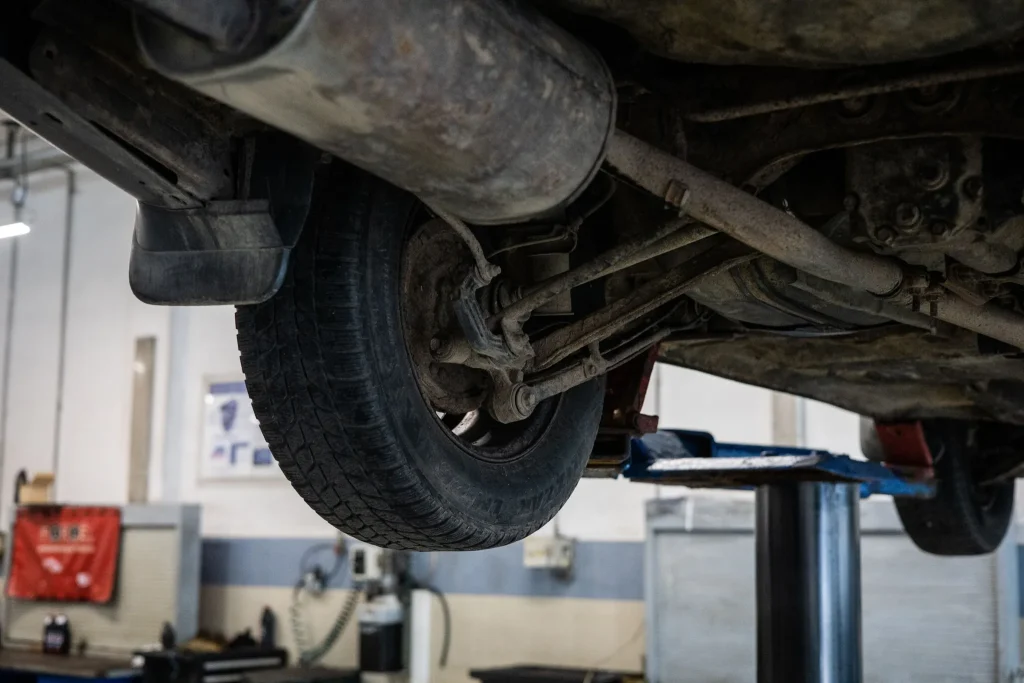
What does a catalytic converter look like? It is a metal casing clearly wider than the exhaust pipe, often round or oval and partly covered by a heat shield. There is usually an oxygen sensor with a wire coming out of it in front of the casing and another behind it. A silencer, by contrast, is usually bigger, sits further back and has no sensors.Only look under the car once the exhaust has cooled down and the car is safely supported on axle stands or ramps. A converter close to the manifold is often easier to see from under the bonnet than from underneath.The side of the casing often carries a manufacturer’s code that identifies the type and value of the part. To find out more about the different units, read our article on which converter types can be recycled.Catalytic Converter Location and Oxygen Sensors
The sensors also give away the catalytic converter location. The upstream oxygen sensor in front of the converter measures how much oxygen is in the exhaust gas, and the engine control unit adjusts the fuel supply accordingly. The downstream sensor behind the converter shows how well it is working. When the converter deteriorates, the on-board diagnostics (OBD) system picks it up from the sensor signals and can store fault code P0420.Why Does Position Affect How the Converter Works?
Above all, position decides how quickly the converter warms up. A cold converter does not clean exhaust gases effectively yet, so one mounted close to the engine starts working sooner than one under the floor. In Finnish conditions this matters, because on short winter journeys the converter spends a larger share of the trip below its operating temperature.The heat has a downside too. Close to the engine, the converter is under greater thermal stress, and engine misfires, for example, can overheat it. That is why it is worth having the converter checked if the engine has been running unevenly.Catalytic Converter in Car Parks and Driveways: Theft Risk
Thieves target a catalytic converter in car parks and on driveways because its coating contains platinum, palladium and rhodium. An underfloor unit is easier to remove than one in the engine bay. According to Finnish police, a professional can saw it off the exhaust of a parked car in a few minutes.The problem is familiar in Finland. According to Verkkouutiset, the National Bureau of Investigation recorded almost 700 reports of catalytic converter theft in 2020, and the police say Honda, Toyota, Volvo and Opel cars have been targeted most often.Police advice on preventing theft includes:- fitting a protective plate in front of the converter
- engraving your registration number on the converter
- painting the converter in a heat-resistant, eye-catching colour
- parking in a well-lit or highly visible spot
How Can You Tell the Converter Has Been Stolen?
You will usually notice a stolen converter as soon as you start the car: the exhaust is suddenly much louder because the gases escape from a cut pipe. The engine warning light comes on when the oxygen sensors stop getting the signal they expect, and you may see sawn-off pipe ends under the car.Removal often causes other damage as well. According to a joint statement by Finnish car recycling organisations, additional damage occurs mainly because thieves remove the converter quickly and carelessly. The repair may therefore involve pipes, mountings or sensor wiring as well as the converter itself.When buying a used car, take a look at the converter casing too. The same organisations report cases where converters have been emptied of their ceramic core, welded shut and refitted. Fresh welds on the casing are a good reason to ask more questions.Missing Converter and the Annual Inspection
If the converter has been stolen or removed, the car will not pass its annual inspection in Finland. Under the Traficom inspection regulation, a missing converter on a car that requires one is grounds for failure. On petrol cars up to 10 years old, a stored fault code in the range P0001-P0499, which includes P0420, also leads to a fail.What Does Position Mean When You Sell an Old Converter?
The position tells you how many saleable units the car has and how they come off. If there is a pre-catalyst and a main converter, or two units on a V engine, keep them all. According to Metalaxis, a used converter in Finland is typically worth between €50 and €900 in 2026, depending on the model and its metal content.How many catalytic converters does your car have?
Find the situation that matches your car.Conclusion
The converter sits in the exhaust system between the engine and the silencer: on modern cars usually in the engine bay right after the exhaust manifold, on older cars under the floor. Some cars have two or more units. The position affects how quickly the converter warms up, how easily it can be stolen and how it is removed for sale.If you have a used catalytic converter, send Metalaxis a photo of its code via WhatsApp, by phone or by email, and you will receive a price estimate based on analysis. We serve customers across Finland.FAQ
The catalytic converter sits in the exhaust system between the exhaust manifold and the silencer. On modern cars it is usually in the engine bay right after the exhaust manifold, while on older cars it is normally under the floor, roughly beneath the front seats.
Many cars have one converter, but some have a small pre-catalyst near the engine and a larger main converter under the floor. On V engines each bank of cylinders can have its own converter, so the car may have two or more.
It is a metal casing wider than the exhaust pipe, often round or oval and partly covered by a heat shield. There is usually an oxygen sensor in front of it and another behind it. A silencer is bigger, sits further back and has no sensors.
On a diesel car the oxidation catalyst is usually close to the engine, followed by the diesel particulate filter and often an SCR system. A particulate filter is not a catalytic converter, even when both share a casing.
Exhaust gas is hottest near the exhaust manifold, so the converter warms up quickly and starts cleaning emissions soon after a cold start. This matters most on short journeys and in cold weather.
The converter’s coating contains platinum, palladium and rhodium, and an underfloor unit is easy to saw off. According to Finnish police, a professional can remove one from a parked car in a few minutes.
No, not if the car requires one. Under the Traficom inspection regulation in Finland, a missing converter on a car that requires one is grounds for failure.
Remove it intact, do not open the casing and keep the code on the shell readable. According to Metalaxis, a used converter in Finland is typically worth between €50 and €900 in 2026, depending on the model and its metal content.


