
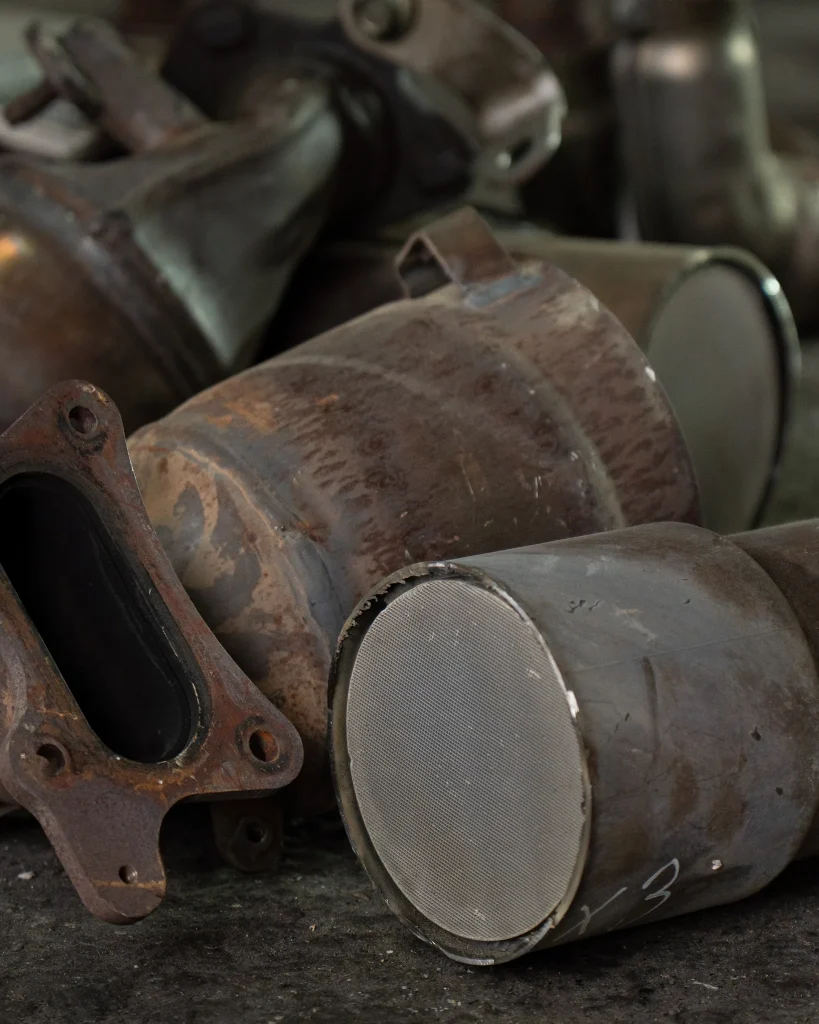

Overview: A removed converter is not scrap. It is a part with a measurable material value. This guide brings the whole subject together: where the value comes from, how the price is calculated, what the various scrap-price terms actually mean, what a seller should do before the sale, how business sales differ from private ones, and what the law and the tax rules require. Each section ends with a link into a dedicated guide if you want to go deeper.
Key Takeaways
- The value is in the coating, not the steel casing. Platinum, palladium and rhodium sit as a thin layer on the honeycomb.
- Price comes from measurement, not estimation. Code identification and XRF analysis replace a visual guess.
- Scrap price and analysis price are different things. A unit sold by weight returns a fraction of what the same unit returns when sold by content.
- The range is wide for a reason: in Finland a single unit typically falls between about 50 and 900 euros, and rhodium-rich units can exceed that.
- Keep the unit intact. An opened or emptied housing loses both its value and its identifiability.
- Business sales have their own rules – the reverse charge VAT applies to trade between VAT-registered businesses.
- A working unit may not be removed from a vehicle that is in road use.
What does selling a converter actually involve?
When a new unit is fitted to a car, the old one is left with the garage or the owner. At that moment one practical question appears: where does the part go, and what should it be worth?
The answer depends entirely on who buys it. The same physical catalytic converter can return a few euros or several hundred, depending on whether it is assessed by weight or by content. That single distinction is the core of this subject, and it recurs in every section below.
This guide to catalytic converter recycling follows the chain from start to finish. If you are after a quick answer to one question, each section ends with a link to the guide that covers it in depth.
Where does the value come from?
The value comes from the precious metal coating on the surface of the honeycomb. The ceramic or metallic core is coated with a thin layer of platinum, palladium and rhodium, and those metals drive the reactions that clean the exhaust gases.
The steel casing is worth very little. It weighs a lot and sells for little. The coating weighs almost nothing and sells for a great deal. The practical conclusion for a seller follows directly: the size or weight of a unit tells you almost nothing about what it is worth.
Three metals, three different price curves
Platinum, palladium and rhodium are separately traded commodities whose prices move at different rates and in different directions. Diesel converters lean towards platinum, petrol units towards palladium and rhodium. Rhodium is typically the most valuable of the three and clearly the most volatile.
In practice this means two similar-sized units from different cars can be worth very different amounts, and that the same unit can change in value within a week. The price is not a property the part has. It is the result of a calculation on a given day.
Why a used unit is richer than ore
The economics are explained by concentration. A 2025 review in Resources, Conservation and Recycling reports platinum group metal content in spent automotive catalysts at 1,000 to 3,000 grams per tonne, while grades in natural deposits generally stay below 10 grams per tonne.
That is roughly a hundredfold difference. It is why a used converter is handled as an industrial raw material rather than as waste, and why real money is paid for it. The same review notes that spent automotive catalysts have become the principal source of platinum group metal supply – recycling is not a supplement to mining but a replacement for it.
Catalytic converter value: how the price is calculated
A reliable assessment of catalytic converter value runs in three stages. Once you know them, you can also judge whether an offer you receive is reasoned or guessed.
Stage 1: identification by code
A manufacturer’s code is usually stamped into the side of the housing. It identifies the model, and the unit can be matched against a database of thousands of previously analysed parts. This gives a reference loading before anything is opened.
The code is therefore the single most useful piece of information a seller can send in advance. How to read it, and what to do when it has corroded away, is covered in the guide to valuing a converter by its code.
Stage 2: XRF analysis
A reference figure is not enough, because individual units of the same model differ and a part may be damaged. So the content is measured. XRF analysis, or X-ray fluorescence, determines how much platinum, palladium and rhodium the sample actually contains.
The difference from an estimate matters. An estimate is based on what this type of unit usually holds. A measurement is based on what this particular unit holds.
In practice the measurement requires the core to be removed from the housing, milled and mixed to a uniform powder. Without mixing, a sample taken from one area would not represent the whole lot, because the coating is not evenly distributed through the honeycomb. This is also why a seller should not open the unit: dismantling is part of the analysis, not a preparation for it.
Stage 3: the catalytic converter price against the day’s market
Once the content is known, it is multiplied by that day’s metal quotations and the costs of processing and refining are deducted. The result is an offer. The individual factors behind that figure are set out in detail in our guide on how the figure is built up.
Catalytic converter scrap price and scrap catalytic converter price: what do they mean?
Catalytic converter scrap price and scrap catalytic converter price are search terms for the same thing: how much a part that is out of service is worth. The words come from the scrap trade, and they mislead, because they imply pricing by weight.
In practice the opposite applies. A converter’s scrap value does not come from scrap metal but from what remains in the core. This is why the part should not be taken somewhere that weighs it in with the rest of the steel – at that moment the entire precious metal content disappears from the pricing.
Catalytic converter scrap value compared with an analysis-based price
Catalytic converter scrap value, in the general scrap-yard sense, means a fixed per-piece or per-kilo figure. It is fast, but it is based on an average rather than a measurement, and an average is by definition wrong for every individual unit.
A specialist recycler’s price is based on identification and analysis. The gap between the two is what a seller loses when a unit ends up in the wrong pile. The most common misconceptions about this are addressed in myths and misconceptions about catalytic converter recycling.
The same part, two prices
A converter’s value depends on how it is assessed, not on what it looks like.
Sold by weight
- Weighed in with the rest of the steel
- Price = the per-kilo rate for scrap metal
- The coating makes no difference
- No analysis and no documentation
Result: The value of the steel
Sold by content
- Identified from the code on the housing
- XRF analysis measures platinum, palladium and rhodium
- Price = measured loading x the day’s market rate
- Analysis report and a receipt for the sale
Result: Typically 50 to 900 euros in Finland
The gap between the two is not measured in percentages. It is measured in orders of magnitude.
Used catalytic converter price: why is the range so wide?
A used catalytic converter price in Finland typically falls between about 50 and 900 euros. The range is wide, and it confuses sellers for good reason – 50 and 900 euros are entirely different orders of magnitude.
The explanation is straightforward. The bottom of the range holds units from small petrol cars and aftermarket replacements, where there is little precious metal. The top holds hybrids, large diesels and high-output engines, where the loading is several times higher. No single figure describes the market, because the market consists of very different parts.
Current price levels and a table by vehicle class are available in how much is a catalytic converter worth in Finland in 2026. If you want to know which models sit at the top and why, the comparison is in the most valuable catalytic converters.
Where to sell a catalytic converter: three routes
If you want to sell a catalytic converter, there are three practical routes, and they differ from one another more than most people assume.
A specialist recycler identifies the unit, analyses the content and prices it on measured loading. This normally produces the best price and handles the documentation as part of the process.
A general scrap yard offers a fixed price quickly. The route is convenient, but the price is based on an average.
A private online sale leaves identification, proof of origin and the correctness of the price to the seller. The risk is highest and the outcome least certain.
A detailed comparison of the routes and a practical seller’s checklist are in the guide to selling a used catalytic converter.
Before you sell: five things worth doing
A handful of simple steps affect the outcome more than the choice of buyer does.
- Keep the unit intact. Do not open the housing or empty the core. An opened unit is both harder to identify and clearly worth less.
- Clean the markings so they are legible. A wire brush is enough to clear surface rust from the code.
- Record the vehicle details. Make, model, year and engine type narrow the options even if the code is missing.
- Keep units separate. A mixed batch cannot be priced accurately, because the units cannot be assessed as one.
- Ask for an estimate before transport. A photograph of the housing and its code is enough for a preliminary figure, and that figure gives you a benchmark for every offer.
When is the right time to sell?
Because the price follows metal quotations, timing matters. Metal prices can move several per cent within a week, and rhodium is clearly the most volatile of the three.
For a single unit, however, thinking about timing is rarely worth it. The difference over a few weeks is typically tens of euros, while the risk of storage is real: a converter is a theft target when loose as well as when fitted, and it does not gain value sitting in a garage.
For a larger batch the calculation changes. With dozens of units, a one per cent move in metal prices is visible in the total, and market monitoring or a price lock agreed with the buyer can be justified. The rule of thumb: a private seller sells when the part is in hand, a business agrees a regular collection rhythm and watches the market alongside it.
What happens to the part after the sale?
From the seller’s point of view the transaction ends with payment, but the material’s journey continues. The chain is worth knowing, because it explains why the price is what it is and why documentation is requested.
Dismantling and homogenising
The steel housing is opened and the ceramic or metallic core is recovered. The core is milled to a powder and mixed so that a sample representing the whole lot can be taken. The steel goes into its own metal cycle, but its value in the chain is small.
Analysis and batch formation
The sample is analysed for platinum, palladium and rhodium content. The result is recorded and the material joins a larger batch destined for a refinery. At this point an individual seller’s part stops being a separate object and becomes a measured quantity of metal.
Refining and the return to industry
At the refinery the metals are separated and purified. The recovered platinum, palladium and rhodium return to industrial use – new converters, electronics, glass manufacturing or hydrogen technology. The loop closes, and that is precisely why a seller is paid for the material rather than charged to dispose of it.
Five mistakes that cost sellers money
Most of the value that goes missing is not lost to a poor offer but to a few recurring errors.
1. Opening the unit before selling. A common assumption is that the core alone is worth more than the complete unit. It is not. An opened part cannot be identified reliably, and an emptied housing is effectively worthless.
2. Selling by weight. If the unit ends up with mixed metal, it is paid for as steel. The gap to an analysis-based price is typically two or three orders of magnitude.
3. Accepting a price before identification. A figure quoted over the phone with no code and no photographs is not an offer on the part. It is an offer on the seller’s uncertainty.
4. Mixing batches together. When units from different vehicles and of different types sit in one pile, they cannot be assessed separately. Sorting costs nothing and affects the outcome more than any other single action.
5. Throwing away the paperwork. A garage receipt or replacement job sheet shows which vehicle the part came from. It speeds up the assessment and removes questions about origin – particularly when the housing markings have worn away.
Check first which part you actually have
One of the most common mistakes is made before price is even considered: the part is assumed to be a converter when it is in fact a particulate filter or an SCR unit. A modern diesel car can have three or four separate housings in sequence along the exhaust, and once removed they look very much alike.
The difference matters, because an SCR core is based on a vanadia or zeolite active material and does not contain precious metals in the way a converter does. Telling the parts apart by position, sensor ports and markings is covered in DPF or catalytic converter: how to identify the part.
Selling for businesses: workshops and dismantlers
For a workshop, a dismantler or a dealership, a converter is a by-product. Units arise alongside normal work, and acquiring them costs nothing. That is exactly why the return depends almost entirely on process rather than on sourcing.
Three things decide it in practice: units are kept intact, they are kept separate from other scrap, and each one is recorded against the vehicle it came from. With those in place a batch can be assessed at once and collected on a schedule, turning occasional sales into a predictable revenue stream.
The logistics, pricing and documentation of volume supply are covered separately in selling catalytic converters for businesses.
How to recognise a trustworthy buyer
The choice of buyer determines the outcome as much as the condition of the part. A reliable operator is recognisable from a few concrete things, and none of them is a promise of the best price.
They explain how the price is formed. If a buyer cannot explain how the offer was calculated, it is not a calculation but an estimate. Ask for the breakdown: what loading was measured, and at what price it was valued.
They ask about origin. Questions about the vehicle and the paperwork are not obstruction. They are a sign that the operator keeps stolen material out of the chain. A buyer who asks nothing also records nothing.
They hold the necessary permits. A professional recycler operates under environmental permits and is entered in the waste management register. You can ask this directly, and the answer should come without hesitation.
They pay traceably. A bank transfer and a receipt protect both sides. They show that the transaction took place and on what terms.
Legality, documentation and tax
Selling a used converter is lawful in Finland when the part comes from a lawful source. The boundary is clear: a replaced unit, or one removed from a properly scrapped vehicle, may go to recycling, but a working unit may not be removed from a vehicle that is in road use.
When a whole vehicle is taken out of use, it must be delivered to official recycling. According to Traficom, this produces a certificate of destruction and the vehicle is permanently removed from the register.
Private seller or business: the tax treatment differs
An occasional sale by a private individual is simple: the part is sold, the transaction is documented and payment arrives in the account. Trade between businesses, by contrast, often falls under the reverse charge VAT for the scrap sector.
According to the Finnish Tax Administration, the reverse charge applies where the sale concerns scrap metal or metal waste, where both seller and buyer are businesses entered in the VAT register, and where the sale takes place in Finland. In that case the buyer reports and pays the VAT, not the seller. The seller must still issue an invoice carrying the buyer’s business ID and a note on the reverse charge, but without a tax rate or tax amount.
The same guidance also applies to an occasional seller of scrap metal, so a business should check the treatment in advance even for a single batch.
Private seller or business? How the sale differs
The part is the same. The obligations are not.
Private seller
- What to bring
- The part intact, the vehicle details and photo identification
- VAT
- Does not apply to an occasional private sale
- Invoicing
- No invoice required
- Who accounts for the VAT
- –
- Delivery
- A single unit, delivered or collected as agreed
Business
- What to bring
- The same, plus a record of origin for each unit
- VAT
- Reverse charge applies when both parties are in the VAT register
- Invoicing
- Invoice without a tax rate, carrying the buyer’s business ID and a note on the reverse charge
- Who accounts for the VAT
- The buyer, not the seller
- Delivery
- Batches on an agreed collection schedule
Source: Finnish Tax Administration, reverse charge VAT in the scrap sector.
Why recycling matters environmentally as well
Beyond the commercial side, recycling has a measurable environmental effect. A 2024 life cycle assessment published in Sustainability compared producing platinum from ore and from recycled material. Producing a kilogram from ore generated around 13,500 kilograms of carbon dioxide equivalent, while the recycled route generated around 694 kilograms. The difference is roughly 95 per cent.
The same study put the reduction in resource depletion at around 93 per cent. In practice every gram recovered is a gram that does not have to be mined – and recycling is not only the seller’s benefit but part of a working material cycle.
Summary
Selling a converter comes down to three things. Identify the part, so you know what you are selling. Sell to a buyer who measures the content rather than guessing it. Keep the unit intact and the paperwork to hand, so the transaction proceeds without questions.
Do those, and you get what is actually in the part. Skip them, and you are selling a steel canister. Send a photograph of the housing and the code it carries to Metalaxis catalytic converter recycling, and you will have an assessment before the part goes anywhere.
FAQ
A single unit typically falls between about 50 and 900 euros in Finland, and units rich in rhodium can exceed that. The final figure depends on the precious metal loading, the condition of the part and that day’s market prices. An accurate number is only available once the unit has been identified by its code and its content analysed.
Valuation runs in three stages: the part is identified from the code on the housing, its precious metal content is measured by XRF analysis, and the measured loading is priced at the day’s market rates. This way the offer is based on what that particular unit contains, rather than on what a unit of that type usually contains.
Usually not. A scrap yard typically prices the part by weight or at a fixed per-piece rate, which ignores the precious metal content of the core. A specialist recycler identifies the unit and pays on measured content, which normally produces several times the weight-based figure.
Not in practice – both are ways of asking how much a part that is out of service is worth. Both terms point at the scrap trade, but a converter’s value does not come from scrap metal. It comes from the precious metal coating on the core, so pricing is done by content rather than by weight.
Yes, when the part comes from a lawful source, meaning it was replaced at a garage or removed from a properly scrapped vehicle. A working converter may not be removed from a car that is in road use. When a whole vehicle is taken out of use it goes to official recycling, which issues a certificate of destruction.
Trade between businesses often falls under the reverse charge VAT for the scrap sector, where the buyer rather than the seller reports and pays the VAT. The conditions are that the sale concerns scrap metal, that both parties are entered in the VAT register, and that the sale takes place in Finland. The seller must still issue an invoice showing the buyer’s business ID and a note on the reverse charge.
Because their content and value differ substantially even though removed parts look alike. An oxidation catalyst contains platinum and palladium, a particulate filter’s coating varies by model, and an SCR unit is based on a vanadia or zeolite active material and does not contain precious metals in the same way. The wrong assumption leads to the wrong price expectation.
The part is still identifiable. Housing dimensions, core structure, port positions and the vehicle’s own details usually narrow it to a handful of options. Keep the garage paperwork showing the make, model, year and engine code – between them they substitute for a missing stamp almost completely.


